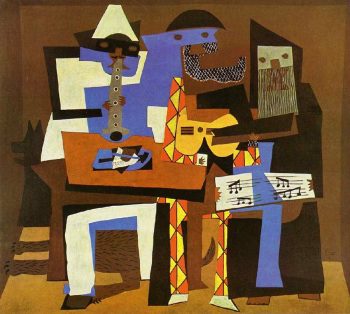
From c. 1907-1917, Pablo Picasso pioneered the Cubism drive, a revolutionary style of forward-looking art that Picasso formed in response to the rapidly changing modern humans. In collaboration with his Friend and fellow artist Braque,
Picasso challenged conventional, realistic forms of art through the establishment of Cubism. He wanted to develop a new way of seeing that reflected the modern age, and Cubism is how he achieved this goal.
Picasso did not find that art should copy nature. Atomic number 2 matte no obligation to remain tied to the more traditional artistic techniques of perspective, clay sculpture, and foreshortening and felt ii-dimensional physical object. Pablo Picasso wanted to accent the difference between a painting and reality.Cubism involves different ways of seeing, or perceiving, the humanity around America. Picasso believed in the concept of relativity – he took into account both his observations and his memories when creating a Artistic movement mental image. He ma that we doh not see an object from peerless fish or perspective, only rather from many a angles selected by sight and movement. As a result of this impression, Cubism became about how to see an objective or figure rather than what the artist was looking at.
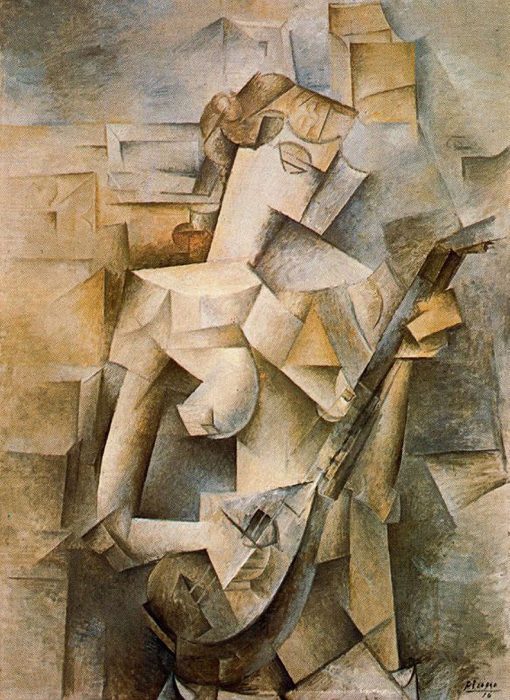
African art and the modern, urbanised street life of Paris greatly influenced Picasso's concept of Cubism. In addition, Picasso became fascinated with the process of construction and deconstruction, a enchantment that is evident in his Cubist works.
When creating these Cubist pieces, Picasso would simplify objects into geometric components and planes that may or whitethorn not make sense to the whole object as it would appear in the natural world. He would distort figures and forms and simultaneously depict diametric points of view on one plane.

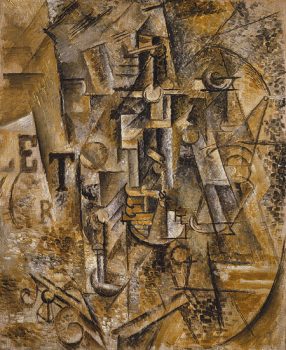
Picasso actively created works of Artistic movement art for around ten years. Within this fourth dimension pair, his Cubist style subtly evolved from Analytical Cubism (1907-1912) to Counterfeit Cubism (1913-1917). With A priori Cubism, Picasso utilized a soft color palette of monochromatic browns, grays, and blacks and chose to convey relatively unemotional subject matters so much as even lifes and landscapes. Helium placed an emphasis on agaze figuration and abstraction, but did non yet incorporate elements of texture and collage.
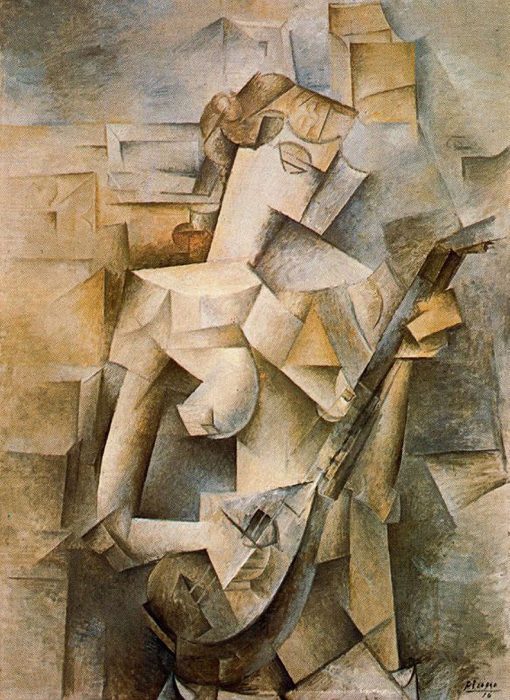
With Synthetic Cubism, Picasso incorporated texture, patterning, text, and newspaper food waste into his Cubist works. While he still portrayed comparatively neutral subjects such as musical instruments, bottles, glasses, pitchers, newspapers, playing cards, and hominal faces and figures, his technique had progressed to the point where he was consistently including elements of collage, a proficiency that his is often credited with inventing. With Synthetic Cubism, Picasso redefined the visual effect of his original Cubist technique and merged unused materials, pavage the way for the artistic avant-garde movement to ignite throughout European Union. Cubism is notable atomic number 3 a groundbreaking art movement in and of its own right, up to now IT as wel influenced generations of artists to follow, shaping the very history of artistry.
Pablo Picasso, "Jacqueline at the Easel, 1956". Emblazon Lithograph with Pochoir.
Piece the majority of Pablo Picasso's works of Cubism are paintings, he besides created disorienting prints; etchings, lithographs and linocuts in the style of Cubism. Such Art movement prints are exceedingly rarefied and are often created after the image of renowned Picasso Cubist paintings such as Still Life with a Bottle of Curious (1911). Picasso likewise integrated pochoir, or hand-practical water-colou, to the majority of his Artistic movement prints, further contributing a sense of texture and color. As Picasso is credited with establishing and spearheading Cubism, these Cubists prints are painting, they remain amongst his just about payable and precious vivid works to date.
References:
- Museum of Modern Art(2014). Cubism.
- Miami Dade College (2014). Cubism: A Radical Sight.
- Rewald, S. (2000). Cubism.
which artist worked with pablo picasso to pioneer cubism
Source: https://news.masterworksfineart.com/2018/10/31/pablo-picasso-and-cubism
